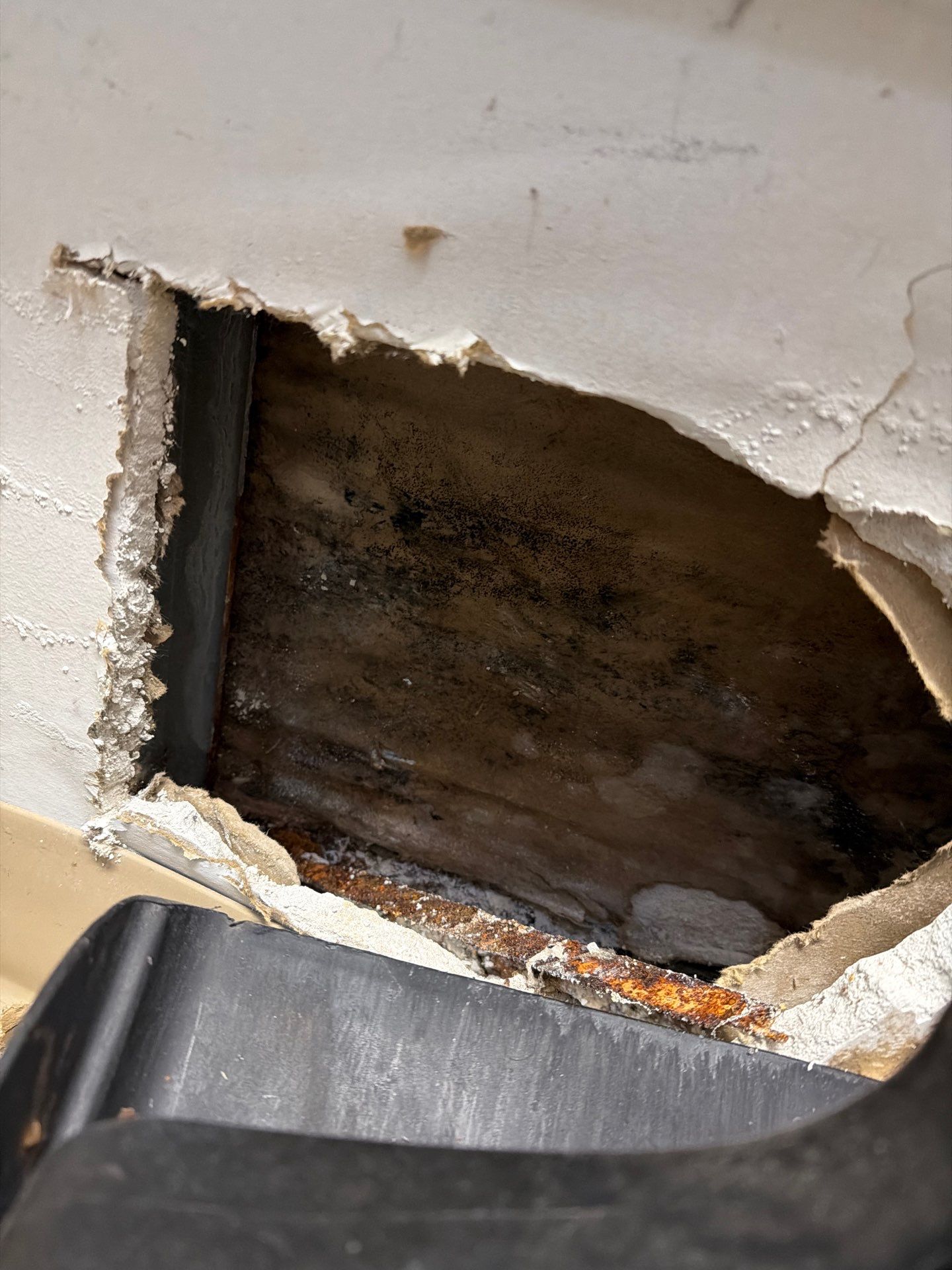
Problem: Water Has Soaked Into Drywall and You Cannot See How Far It Spread
Drywall acts like a sponge. A small leak from a sink supply line can wick up 12 to 18 inches above the visible stain, and gypsum that looks dry to the touch can still hold 25 percent or more moisture content. Paint can mask discoloration for weeks. Meanwhile, the paper backing feeds mold spores that activate within 48 to 72 hours.
Solution: Moisture Mapping and Controlled Demolition
We start with calibrated moisture meters and thermal imaging to draw the actual edge of the wet zone, not the stained zone. From there we make controlled cuts, usually flood cuts at 2 feet or 4 feet, so the new drywall lands on a stud and the seam disappears after finishing. Wet insulation comes out in bags. Cavities get dried with directed air movers and a dehumidifier sized to the cubic footage. For deeper hidden saturation, our team uses the same techniques covered in our guide on water damage behind walls and hidden leak detection, because guessing on coverage area is how mold jobs are born six months later.
Wall type changes the playbook too. Plaster walls in older Hazel Dell homes hold water differently than modern drywall, often trapping moisture against the lath for weeks. Tile backer board around tubs and showers can stay wet long after the surrounding drywall reads dry. We probe each material separately and adjust the demolition line accordingly so we are not opening more wall than needed, and not leaving wet pockets behind a fresh patch.
Problem: The Floor Feels Spongy, Cups, or Has Started to Buckle
Hardwood, engineered plank, laminate, and LVP all react differently to a plumbing leak. Solid oak can sometimes be dried in place if we get there fast. Laminate almost never survives because the fiberboard core swells permanently. Tile may look fine while the subfloor underneath is saturated and beginning to delaminate.
Problem: The Leak Stopped, But You Still Smell Something Musty
Stopping the leak is step one, not the finish line. Trapped moisture inside wall cavities, under cabinet toe-kicks, and beneath flooring keeps releasing humidity into the room. That smell is microbial growth on cellulose materials, and it will not air out on its own.
Solution: One Team Through Drying and Rebuild
Hazel Dell Water Restoration handles both phases. Once moisture is verified down, the same project manager schedules drywall hang and finish, primer and paint, flooring replacement or refinishing, baseboards, and final cleaning. Two or three vendors become one point of contact, and the timeline tightens by days. Typical plumbing leak repairs in Hazel Dell run 5 to 14 days from start to walkthrough, depending on the size of the affected area and whether cabinets or ceilings are involved.
Solution: Claim-Ready Documentation From Hour One
Before any demolition, we photograph affected rooms, log moisture readings, note the source of loss, and write a scope using Xactimate, the same software your adjuster uses. That removes most of the back-and-forth on line items. We also coordinate directly with your adjuster when you want us to, and we explain what is included in mitigation versus reconstruction so nothing falls through the cracks. For a deeper dive on numbers, our complete price breakdown for water damage restoration walks through realistic ranges for Hazel Dell homes.
A few practical tips while you wait for the adjuster to arrive:
- Take wide and close-up photos of every wet surface before anything is moved or thrown away.
- Save a section of damaged flooring, drywall, or the failed supply line as a physical sample.
- Keep receipts for hotel stays, meals out, and any emergency purchases tied to the loss.
Problem: You Do Not Know What Insurance Will and Will Not Pay For
Most homeowner policies in Hazel Dell cover sudden and accidental plumbing leaks, including the resulting water damage to walls, floors, cabinets, and contents. They typically do not cover the failed pipe itself, long-term seepage, or damage from a leak you knew about and did not address.
Problem: You Need Repairs Done, Not Just Drying
Mitigation gets the structure dry. Reconstruction puts it back. Many companies stop after extraction and hand you a list of subs. That leaves you project-managing drywall, paint, flooring, and trim during the worst week of your year.
Solution: Material-Specific Drying and Subfloor Recovery
Three things drive the floor decision:
- How long the water sat. Under 24 hours gives us the best shot at saving hardwood with mat drying systems.
- What category the water was. Clean supply line water is Category 1. Dishwasher or washing machine discharge is often Category 2. Sewage or long-stagnant water is Category 3 and the flooring usually has to go.
- Whether the subfloor is plywood or OSB. OSB swells faster and rarely returns to spec.
We pull base trim, lift affected planks if needed, and use injectidry panels to push warm dry air under the surface. If you want a deeper look at whether your floors can be saved, our breakdown on hardwood floor water damage and the save-or-replace decision covers the moisture thresholds we use on every job.
Solution: Targeted Drying With Documented Readings
Our crews set drying equipment based on psychrometric readings, then return daily to log temperature, relative humidity, and material moisture content. Drying is finished when wood framing reads under 16 percent and drywall is back to its dry standard, not when it feels okay to the touch. Documentation matters for two reasons. First, it tells us when to pull equipment so you stop paying for power. Second, it gives your adjuster the proof they need to approve the claim.
Why Air Movers Alone Are Not Enough
Plenty of homeowners rent a few fans from a hardware store and assume that solves it. Air movement without dehumidification just relocates the moisture into your ceiling, your closet, and the next room. We pair high-velocity air movers with low-grain refrigerant or desiccant dehumidifiers, sized to the actual cubic footage of the affected space. On a typical kitchen leak in Hazel Dell, that might mean two dehumidifiers and six air movers running for three to five days, not a single fan running for a week.